Beyond the Boundaries: What the Utah National Monument Rollbacks Mean for California’s Public Lands
The recent reduction of the Bears Ears and Grand Staircase-Escalante National Monuments in Utah represent a concerning shift in federal public lands policy. These National Monument rollbacks are paving the way for broad industrial development, which raises valid concerns for the future of our own protected California landscapes – specifically in places like the San Gabriel Mountains, Berryessa Snow Mountain, and Mojave Trails National Monuments.
Navigating the Crosshairs of Conservation and Extraction
As an outdoor community, we navigate the space between two ends of the public lands spectrum. We know society relies on natural resources. We also understand that public lands help supply them. However, resource use requires careful planning rather than sweeping directives. When policy swings toward extremes, the outdoor experience gets caught in the crosshairs. We believe in a pragmatic middle path. This allows for thoughtful resource use while firmly protecting our most critical landscapes for their natural and recreational values.
A Holistic View of Our Public Lands
For the cycling and trails community, it is easy to view public land policy primarily through the lens of trail access. However, the value of a National Monument extends far beyond where we ride.These designations protect the integrity of the landscape. They safeguard ecosystems, wildlife corridors, and indigenous cultural sites. When management pivots toward extraction, impacts ripple across the entire landscape. Industrial development fragments habitats and alters the recreational experience. These spaces deserve balanced management as complete, healthy ecosystems.
The Value of Monuments to the Cycling Community
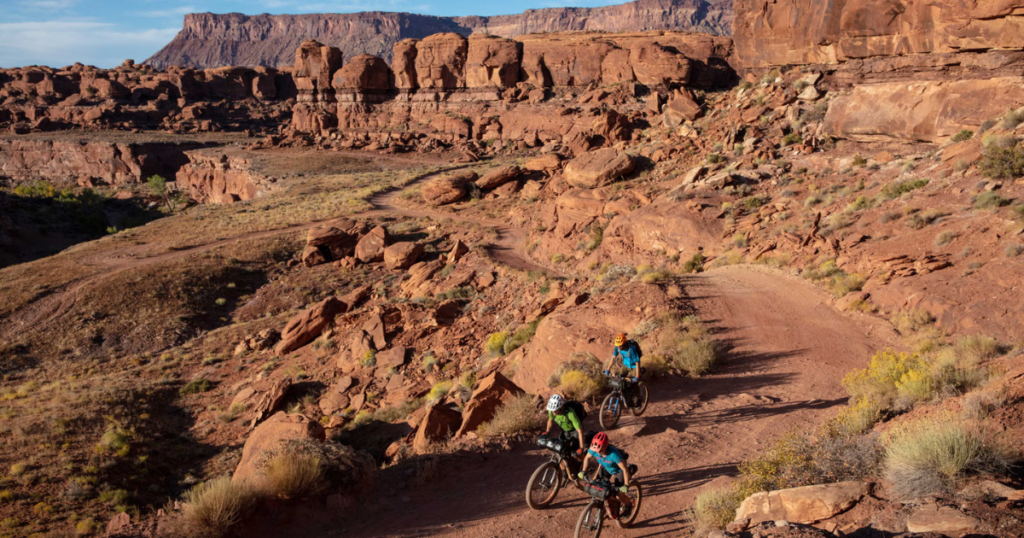
There is a persistent misunderstanding regarding recreation that federal protections impose restrictions on mountain biking. When applied to National Monuments, however, this assumption is typically false. Like Roadless Areas managed by the U.S. Forest Service (USFS), National Monuments, which are typically managed by the Bureau of Land Management (BLM) or the USFS, are highly conducive to mixed recreation. When a monument is established, its management plan can explicitly include and protect mountain biking. These designations secure the vast, intact backcountry that makes singletrack riding and bikepacking possible, shielding the terrain from the types of intensive resource extraction that fracture landscapes and close off areas to the public.
A Decade of Policy Volleys and Follies
To understand the frustration with these rollbacks, look at the history of Bears Ears. The cycling community has tracked this volatility for years. Publications like Bicycling magazine highlighted threats to trails and landscape integrity following the first major reductions nearly a decade ago. The timeline of Bears Ears perfectly illustrates this administrative whiplash:
- 2016: The monument was officially designated, establishing protections for a 1.35-million-acre landscape rich in cultural heritage and backcountry recreation.
- 2017: A new administration drastically reduced the monument’s boundaries by roughly 85%, pivoting management priorities toward potential resource extraction.
- 2021: The Biden administration stepped in to restore the original boundaries, reinstating the protections for both Bears Ears and Grand Staircase-Escalante.
- Today: We find ourselves facing yet another executive rollback, once again stripping protections and altering the trajectory of the landscape.
This cycle of granting, revoking, and restoring protections creates unacceptable uncertainty for recreationists, local communities, and the ecosystems themselves. It is an unstable way to manage our shared natural resources.
Seeking Durable Solutions
Public lands management requires consistent, long-term vision. The current National Monument rollbacks in Utah are a directive of the executive branch, illustrating how fragile administrative protections can be when administrations change. We need a more stable approach to managing our shared resources. While the executive branch has initiated this current reduction, Congress holds the legislative authority to end this enduring match of policy ping-pong. Congress can, and has in the past, step in to establish durable, enduring protections that outlast any single administration, ensuring that public lands are managed with cooler heads, critical thinking, and a long-term perspective.
Stay Informed and Engaged
At a minimum, we encourage all Californians to monitor the ongoing developments at Bears Ears and Grand Staircase-Escalante. The policy standards applied in Utah today serve as the canary in coal mine today for how the federal government may evaluate California’s monuments tomorrow.
If you share these concerns about the future of our public lands, we encourage you to thoughtfully consider speaking up. Our advocacy partners at Outdoor Alliance have set up a straightforward tool to contact your members of Congress. You can use it to urge them to oppose the administrative rollbacks in Utah and to pursue permanent, legislative protections that strike the right balance for our nation’s public lands.
